Separate four different numbers
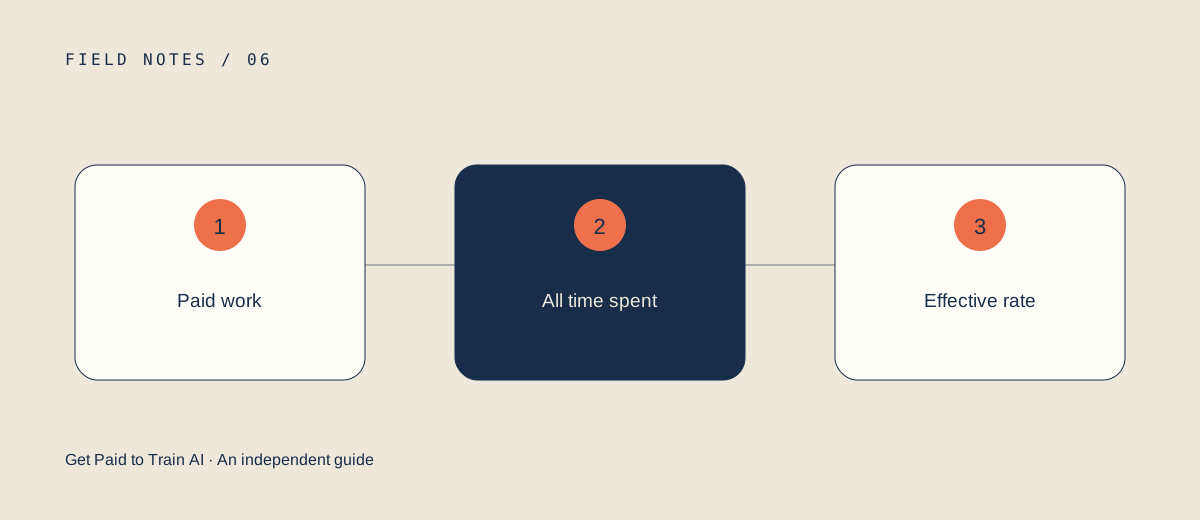
The advertised maximum describes a possible rate under specified conditions. The assigned rate is what your particular task or project offers. Gross earnings are the amount earned before expenses or deductions. Your effective return compares money received with all the time you devoted to obtaining and doing the work.
Keep these numbers separate in your notes. A screenshot showing an impressive maximum does not tell you the distribution of rates, the chance of assignment, or how many billable hours you will have.
Use the rate shown for your work
Outlier’s FAQ says payment may be hourly or per task, with rates affected by expertise, project complexity, and location. It says the tasking rate is shown before the project starts. Use those project terms for your decision rather than applying a general promotional figure to every hour you are available.
For task-based work, find what counts as a completed or accepted task and how timing affects the calculation. Ask for clarification through the platform if the rate, quality condition, or payment unit is unclear.
Work through an illustrative week
Suppose a hypothetical project pays $25 for each paid hour. You complete six paid hours and spend two additional hours on application, preparation, or administration. Gross earnings are 6 × $25 = $150. Across eight total hours, that is $18.75 per hour before expenses or deductions.
If another hypothetical project pays $1 per accepted task and you complete 18 accepted tasks in an hour, that hour produces $18. If you complete 10, it produces $10. These calculations illustrate the arithmetic only; they do not predict acceptance, task availability, speed, or typical earnings.
Track time without retaining confidential tasks
Use a personal log of date, total time, payment received, and general expense categories where your agreement allows. Do not copy task prompts, customer information, screenshots, or restricted project materials into a private spreadsheet.
Separate amounts shown as pending from amounts received. Check whether a payment service or currency conversion changes what arrives. Review the project’s payment schedule and dispute process so you know when a delayed payment requires action.
Make a practical continuation decision
After you have enough real work to assess, compare your effective return with other uses of the same time. Also consider whether the schedule is usable, the instructions are clear, and the work is available when you can do it. A single unusually good or bad day is weak evidence.
Decide in advance when you will review the result and what would make you continue, reduce your time, or stop. Use the platform worksheet before starting and keep your expectations based on completed work.
See what unpaid time changes
Illustrative calculation. Inputs are examples, not typical earnings or guaranteed task hours. Before expenses and taxes.
$20.00/hr
Effective gross rate across all time spent: $200.00 ÷ 10 total hours.
Sources & review
Official sources reviewed November 8, 2026. Requirements and project availability can change; check the current application before acting.